
The Symmetry That Blinds
Has anyone ever been able to explain why orthodox economists routinely, reliably misunderstand monetary systems? More generally, has anyone ever wondered why the mainstream so often gets both sequence and causation wrong, even backwards?
The clearest example is the orthodoxy’s insistence that taxes fund spending, even though the actual operational sequence is unambiguous and verifiable.
Remember: First governments spend and then they tax. Governments can’t tax something that doesn’t exist yet. Citizens can’t pay taxes in dollars if dollars haven’t been spent into existence. In the U.S., the Treasury spends by instructing the Federal Reserve to credit reserve accounts. Dollars — new dollars — now exist in the economy. And the government taxes by instructing the Federal Reserve to debit reserve accounts, which drains some of those dollars out of the economy. The Federal Reserve can’t debit reserve accounts to collect taxes if those reserves haven’t been credited first through spending.
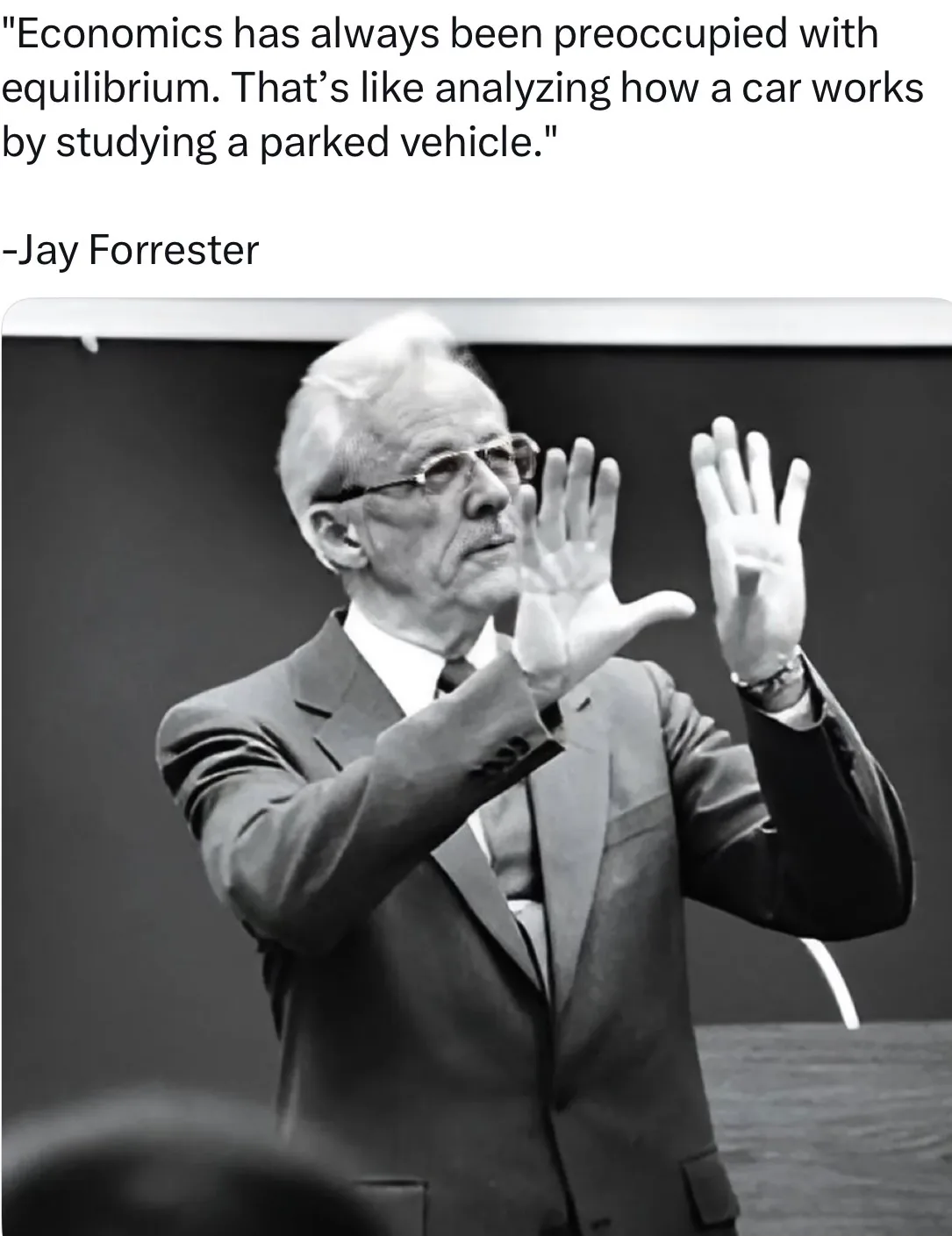
Might one culprit be the neoclassicals’ obsession with equilibrium? Equilibrium analysis is inherently atemporal — treating both sides of the equals sign symmetrically. Whether they are looking at supply = demand, marginal cost = marginal benefit, or savings = investment, their mathematical framework doesn’t privilege one direction of causation over another. It assigns no structural importance to sequence or to time. It’s about the state where things settle, not the process of getting there.
But when something happens matters a lot. “Before” vs. “after” is not symmetric; the actual sequence is fundamental. DSGE, the fashionable “Dynamic Stochastic General Equilibrium” model does no better. Dynamic? It indexes time (t, t+1, t+2), but authentic historical processes, irreversibility, and path dependencies are missing. Stochastic? Uncertainty is reduced to small, very well-behaved shocks around a known structure. And General Equilibrium turns out to be equilibrium imposed by construction, not discovered through interactions.
Asked another way, could it be that the mainstay of the mainstream’s mathematical framework — equilibrium — can’t represent operational realities because it is systematically — and willfully — blind to path-dependent phenomena, seeking timeless solutions to time-bound problems?
Examples abound:
a. The sectoral balance identity (S-I) = (G-T) + (X-M) always holds, but the causation matters enormously. Does a government deficit “crowd out” private saving or enable it? Equilibrium thinking doesn’t help, either suggesting simultaneous determination or that sequence doesn’t matter. But it obviously matters enormously and failing to acknowledge sequence and causation permits empirically refutable, ideologically convenient assertions to prevail.
b. As we know, temporary unemployment tends to morph into permanent unemployment as skills atrophy and discouraged workers exit the labor force. Mainstream models treat this circumstance as structural instead of recognizing that it is path dependent and that austerity actually creates the higher “natural rate” they claim to uncover.
c. The crux of Hyman Minsky’s validated financial instability hypothesis is, of course, path-dependent. Stability breeds instability over time. But equilibrium’s comparative statistics don’t — and can’t — capture this.
In other words, mainstream economics isn’t just wrong about specific conclusions. The failure is foundational. Its core analytical framework is structurally incapable of representing how our economies actually work. And yet these rarely examined concepts are taught as verities year after year, generation after generation.
To be clear, this isn’t just an academic quibble. Most critically, getting causality backwards leads to familiar and devastating policy errors — like austerity that creates the unemployment it claims to address or deficit hysteria that prevents spending on behalf of affordable societal and planetary well-being.
Instead, shouldn’t modern economists hold themselves to a much higher standard, singularly committed to understanding and then improving the very messy real world in all its open-ended complexity and possibility?
This article was originally published on Susan Borden’s Substack and is reproduced here with the author’s permission.