
The Deficit Obsession is Costing Us a Clear View of the Economy
Every time the government runs a deficit, the media and most politicians reach for the same tired metaphors. We are “maxing out the national credit card.” We are “burdening our grandchildren.” We are “living beyond our means.” What almost nobody mentions is the other side of the ledger.
Every pound of government deficit spending that flows into the economy lands on someone else’s balance sheet as an asset. That is not an opinion or a political position. It is a basic principle of double-entry accounting, the same logic that has governed bookkeeping since the fifteenth century. For every liability there is a corresponding asset, somewhere in the system. The question the media never asks is: whose asset is it?
The three-sector framework
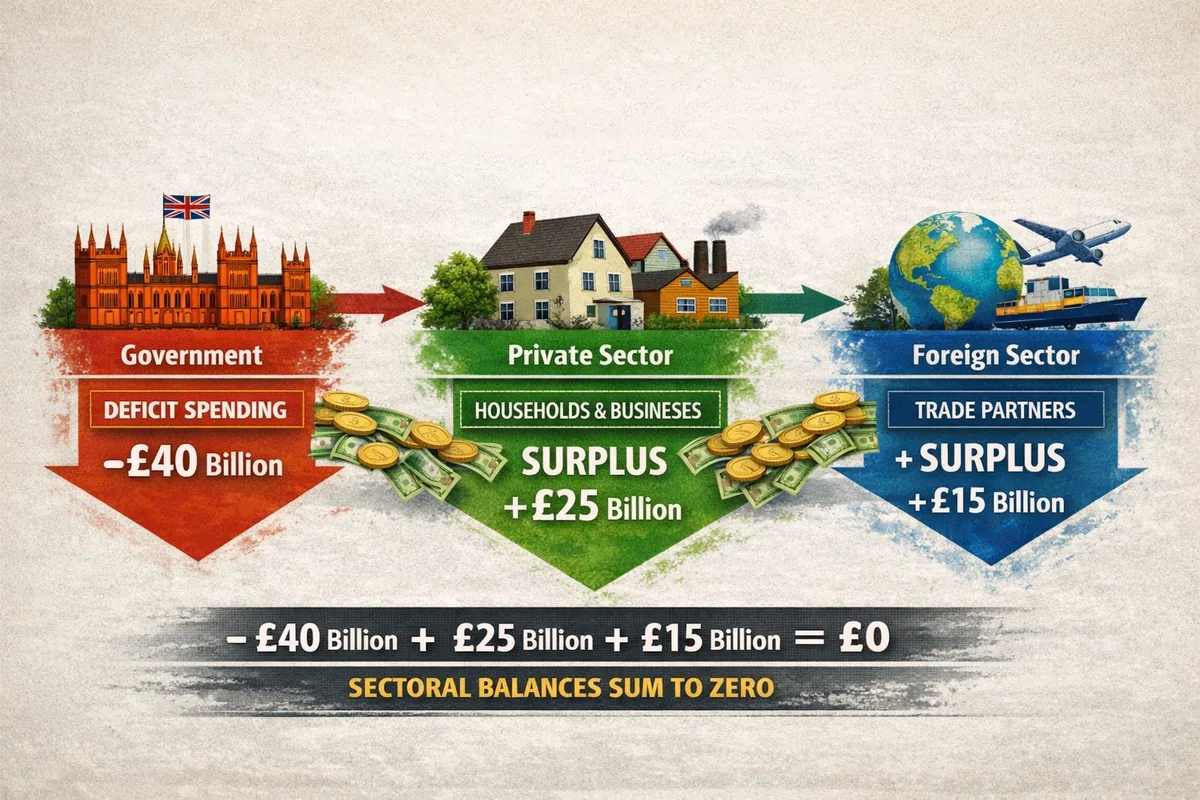
To answer that, you need to understand how economists divide the economy. There are three broad sectors: the government, the domestic private sector (households and businesses), and the foreign sector, meaning everyone else we trade with. The financial positions of all three sectors must, by accounting identity, sum to zero. One sector’s deficit is, by definition, another sector’s surplus.
This framework is known as sectoral balances, developed by the economist Wynne Godley. It does not tell you why these imbalances arise or whether they are sustainable. What it does tell you, with mathematical certainty, is that they are always mirrored. If the government is in deficit, the non-government sectors, taken together, must be in surplus by an identical amount.
The charts below make this concrete. Four economies, four different structural positions. In every case, the sectors balance to zero and someone is always holding the other side of the ledger.
UK Sectoral Balances
The UK chart shows a government almost permanently in deficit, with the exceptions being the brief Lawson boom of the late 1980s and the dot-com era around 1999-2001, both of which coincided with private sector borrowing rather than saving. In 2008-10 the government deficit widened sharply as the private sector moved rapidly into surplus following the financial crisis, and the same dynamic repeated during Covid in 2020.
The austerity programme pursued from 2010 led to a sharp compression of the private sector surplus, which briefly turned negative around 2015-16 as the adjustment fell on output and incomes rather than on the deficit itself, and UK growth remained anaemic throughout the decade. The Rest of World (red) is consistently positive, reflecting the UK’s structural current account deficit: we import substantially more than we export, so the rest of the world accumulates sterling assets.
Both the current account deficit and the private sector’s desire to save are structural features of the UK economy, which means the government deficit is not primarily a political choice: it is the arithmetic residual of those two other positions.
The IMF is forecasting that the private sector surplus narrows considerably in coming years as the Chancellor tightens fiscal policy. On the sectoral balance arithmetic, that adjustment has to land somewhere, and the historical record suggests it lands on growth and employment rather than on the deficit itself.
US Sectoral Balances
The US chart shows a government (green) almost permanently below the line, with the deficit widening sharply during recessions in 2008-09 and again due to Covid in 2020, when it briefly hit around 15% of GDP. One notable feature of the pre-2008 period is that the US private sector (blue) was itself in deficit, meaning households were net borrowers: that was the credit-fuelled consumption boom that ended in the financial crisis.
Post-2008, the private sector flipped to surplus and has remained there, with the government deficit providing the net financial assets that underpin that saving. The Rest of World position (red) stays persistently positive, reflecting the US current account deficit: the world accumulates dollars and dollar-denominated assets, which is part of what sustains demand for US government debt. This is not accidental. As long as the rest of the world wants to send its exports to the US and is content to receive dollars in return, those dollars have to accumulate somewhere. The world’s exporting nations are, in effect, choosing to hold US government liabilities as the price of access to the American consumer market.
What the chart also shows, with rather more clarity than any political speech, is that successive Republican and Democratic administrations have denounced the deficit, promised to eliminate it, and then watched it persist regardless. This is not a failure of political will. It is the accounting asserting itself. As long as that arrangement holds, and as long as the US private sector wants to run a surplus, the government deficit is the residual that makes both positions possible. The theatre of deficit reduction has real costs: it shapes spending priorities, constrains public investment, and generates genuine anxiety among voters. The deficit itself, in a country that issues the world’s reserve currency, remains stubbornly and necessarily present.
Germany Sectoral Balances
Germany presents the mirror image of the standard deficit-panic narrative. The private sector (blue) has been in substantial and growing surplus since the early 2000s, often exceeding 8% of GDP. But unlike Japan or the UK, it is not the government that supplies most of those net financial assets: it is the rest of the world.
Germany’s persistent current account surplus means the RoW (red) sits deep in deficit, financing German private sector saving through trade. The government (green) was in deficit through the 1990s post-reunification, then tightened toward balance and even surplus during the “schwarze Null” era of the 2010s, before Covid forced it back into deficit in 2020.
Not every country can run a current account surplus simultaneously: for every Germany accumulating claims on the rest of the world, there must be a corresponding deficit somewhere else. Germany’s private sector wealth, in this sense, is built on its trading partners’ deficits.
This is worth considering as surplus countries are often held up as models of fiscal virtue. If Germany’s approach were adopted universally, the arithmetic would collapse immediately: there is no rest of the world for the entire world to run a surplus against. The virtue, such as it is, depends entirely on other countries absorbing the corresponding deficits. When a large economy pursues a persistent surplus through wage suppression, domestic consumption restraint, and export-led growth, it is not simply being prudent: it is exporting demand destruction to its trading partners and forcing their private sectors deeper into debt or their governments into larger deficits to compensate. The language of responsibility tends to flow in one direction in these debates. It rarely reaches the surplus countries.
Japan Sectoral Balances
Japan is the most striking chart in the set. Since the mid-1990s, the private sector has run a surplus of between 8% and 13% of GDP virtually without interruption, reflecting an economy in which households and corporations have had an extraordinarily strong desire to save and accumulate financial assets.
The government deficit (green, below the line) has mirrored that almost exactly across the same period. Japan’s Rest of World position is modestly negative, meaning Japan itself runs a current account surplus: the rest of the world borrows from Japan, which slightly offsets the private sector saving desire.
The chart demolishes the claim that large persistent deficits inevitably trigger bond market crises or runaway inflation. Japan has run government deficits of this scale for three decades; its private sector has the net financial assets to show for it.
Savings need a source
This is where the sectoral balance framework becomes genuinely useful, and where conventional deficit commentary goes badly wrong. Households saving for retirement, a deposit, or a rainy day are doing something entirely rational. But their savings have to come from somewhere. Within a purely private financial system, every loan creates a deposit and every asset has a matching liability. Net financial wealth for the private sector, in aggregate, is zero unless money enters from outside.
The government deficit is that external source. As Andrew Berkeley, Richard Tye and Neil Wilson explain in their analysis of UK government spending mechanics: “if the government injects money into the private sector, there exist financial assets which can be accumulated that have no counterpart debt within the private sector.” Government spending, net of taxation, is what allows the private sector to accumulate savings in aggregate without someone else in the private sector taking on an equivalent debt.
Professor L. Randall Wray puts the accounting logic starkly: if the government always runs a balanced budget, the private sector’s net financial wealth will be zero. If the government runs continuous surpluses, the private sector’s net financial wealth must be negative. In other words, if the government insists on spending less than it taxes, the private sector has to go further into debt just to stand still.
The trade deficit complicates things further
The UK imports substantially more than it exports. That current account deficit means non-residents are accumulating sterling balances as savings. Other countries accumulate pounds through their trade with us, and those pounds saved represent a leakage of demand that would otherwise circulate domestically. To prevent that leakage from dragging down output and employment, the government has to compensate by adding more currency back into the system.
This is not a policy choice in the way that building a new hospital is a policy choice. It is a structural arithmetic requirement. As Berkeley, Tye and Wilson note, the size of the government’s deficit is not even entirely within the government’s own control. Tax revenues move with economic activity, and if businesses pull back on investment, the deficit will rise automatically as tax receipts fall. If households choose to save more this will reduce the multiplier effect (from government spending and private sector investment) again reducing tax receipts. Attempts to shrink the deficit without addressing those underlying drivers simply compress economic activity usually by reducing incomes and employment rather than by improving the underlying position.
Who benefits from the deficit?
Here is the question no newspaper splash ever asks. When the Chancellor stands up to announce a borrowing figure, the implicit framing is one of collective irresponsibility. But look at the balance sheets. UK gilts, the instruments through which the government finances its deficit, are held by pension funds, insurance companies, banks, and individual savers. The government’s liability is their asset, often the safest asset available. Households buying Premium Bonds, businesses holding Treasury bills, pension funds matching long-term liabilities with long-dated gilts: all of them depend on a government that runs deficits to supply those instruments.
The UK has maintained its so-called national debt, the accumulated stock of annual deficits, for more than three centuries without default. A currency-issuing sovereign government that borrows in its own currency cannot be forced to default in the way a household or a business can. The constraint on government spending is not solvency. It is inflation: whether the economy has the productive capacity to absorb additional demand without prices rising.
Reframing the debate
None of this means deficits are always appropriate or that size does not matter. The real questions are whether the economy has spare capacity, whether additional spending would be inflationary, and whether the composition of that spending serves public needs. Those are genuine political debates worth having.
What is not worth having, because it rests on a category error, is the ritual performance of deficit panic that treats a £100bn borrowing figure as though it vanished into the void. It did not vanish. It went somewhere. It is sitting in pension funds, on household balance sheets, in the reserves of banks. The deficit is the private sector’s surplus. Until our public debate acknowledges that basic accounting reality, we will keep having the wrong argument about the right numbers.
Sources
- Wilson, Neil and Tye, Richard and Berkeley, Andrew, How does the government spend? A functional model of the UK Exchequer (January 10, 2023). Available at SSRN: https://ssrn.com/abstract=5298653 or http://dx.doi.org/10.2139/ssrn.5298653
- L. Randall Wray, Macroeconomics, Palgrave Macmillan, 2012
- Office for National Statistics, United Kingdom Economic Accounts. https://www.ons.gov.uk/economy/nationalaccounts/uksectoraccounts/datasets/quarterlysectoraccounts
- Wynne Godley (pioneering work on sectoral balances identity: Private Balance + Government Balance + Foreign Balance = 0).https://www.levyinstitute.org/pubs/wp_494.pdf